Showing posts with label Books. Show all posts

Monday, December 11, 2006

Simply Church


I've recently finished reading Simply Church by Tony and Felicity Dale who are part of House2House ministries. It's only a small book (around 100 pages) and a fairly easy read. Tony and Felicity have been involved in church planting and house church movements since the late sixties and have gathered their insights into this book.
A quote from pages 84-85 - "There is no question in our minds that God's intention is for the church to have a structure that enables each person to develop their full potential ... One of the consequences of this is that we have always had an emphasis on small groups. Small is beautiful! In the small group there is the potential for every person to tkae an active part in a meeting ... Does this means there is no place for the large gathering? Absolutely not! Big is beautiful too. There is nothing more inspiring than a large celebration of hunderds, if not thousands of people all worshipping the Lord together. We see in the early church the disciples not only met together from house to house but also in the temple. We know that the apostles taught not just in people's homes, but also in the larger context of the temple courtyard, the synagogue and the hired hall. Some may ask, with this emphasis on the small group, what becomes of the kids? Too often the children are kept out of church meetings as being the "church of tomorrow," when actually they are the church of today. In our experience, the kids play a vital part, particularly in any times of worship. The kids will frequently start a song, or pray for those needing prayer, when they are allowed to participate. We have often seen their contribution bring the Spirit of the Lord directly into a meeting in such a way as to totally change the course of that meeting. The Holy Spirit is no respecter of persons - not by age or gender."

Monday, October 09, 2006

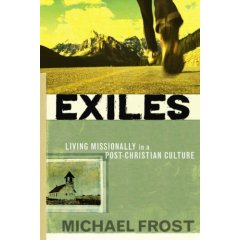
Exiles


I've been travelling a lot lately - which is why there has been little action on the blog. Townsville (twice), Sydney (twice) and Brisbance in the past 3 weeks. Also I've had a week of intensive study on Research Methods for my DMin.
All the travel has given me lots of time to read.
Among the many books I've partially read is Exiles by Mike Frost. Just released in July it is Frosty's (i think I can call him that - I spoken with him twice) latest.
It includes a lot of stories and thoughts I've heard Mike speak of at conferences previously but it is well written and engaging. Heere is a quote from page 63 that particularly resopnated with me.
"If I'm busy several nights a week and all weekend with my church activities, how can I possibly develop a commitment to such frequent proximity? Our churches, under the guise of doing work for Christ, are inadvertently sucking us away from the very people that Jesus would want us to hang out with. . . Exiles have figured out that churches don't value people who won't turn up for every meeting, attend every event, and locate all their significant friendships within the congregation. They have decided to slip away from the ever-spiraling vortex of so-called Christian fellowship. It sucks you in, demanding everything of you, leaving you completely socially disconnected from your neighbours, your community. . . Exiles, having read the dangerous stories of Jesus, have decided that the best way to do the Lord's work is to follow him out into the third places in their community."

Saturday, August 12, 2006

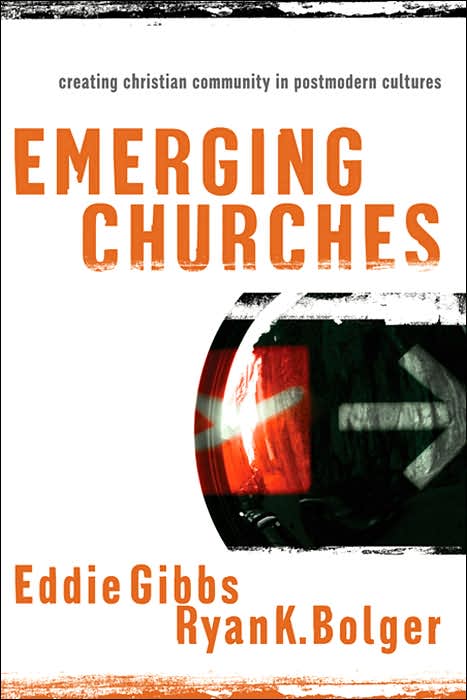
Book Review - Emerging Churches - Gibbs and Bolger

Gibbs, Eddie and Ryan Bolger, Emerging Churches: Creating Christian Community in Postmodern Cultures. Grand Rapids: Baker, 2005

Emerging Churches is a follow on from Eddie Gibbs’ previous book called Church Next which was originally published in 2000 and republished in 2001 with additional information from Ian Coffey which added a UK perspective.
Emerging Churches has similarities to Chruch Next in the content it covers, however, the research methodology is markedly different. Gibbs recognised that he needed to engage face to face with Emerging church leaders across the world in order to define first hand the common characteristics of this movement. Ryan Bolger co-authored the book and used this research as part of his own doctoral studies.
Gibbs and Bolger limit their study to 50 communities in the US and UK and while recognising the existence of similar communities in Australia, New Zealand and continental Europe, they cite a lack of budget (p. 8) for excluding them from the study.
I hope that current doctoral research being undertaken by Darren Cronshaw and the pending releases of Mike Frost’s Exiles: Living Missionally in a Post-Christian World, and Alan Hirsch’s The Forgotten Ways: Reactivating the Missional Church will give us an up to date picture of the emerging (or as most prefer down-under – missional) church in Australia.
Gibbs and Bolger’s intention is to describe what an emerging-missional church is rather than providing a critique of the methodologies or practices. However, they conclude most chapters by identifying the challenges that are presented by these approaches.
Gibbs and Bolger analyse the data collected over a five year period from interviews, forums, discussions, and case studies to identify common characteristics of the emerging church in the US and UK. Nine common practices are identified as “missionally significant” (p.9) and from my perspective they reflect accurately the identified pratices of emerging missional churches in Australia from my own experience. Three core practices are identified as being characteristic of all emerging groups: (1) Identifying with the life of Jesus, (2) transforming secular space, and (3) living as community.
The remaining six practices “are derivitave of these three core practices” (p. 43) and many are evident in each community: (4) Welcoming the stranger, (5) serving with generosity, (6) participating as producers, (7) creating as created beings, (8) leading as a body, and (9) taking part in spiritual activities.
Gibbs and Bolger offer a succinct definition of the emerging (missional) church as “communities that practice the way of Jesus within postmodern cultures (p. 44).” While this may be true of the current movement, I see it more as a new way of being the church that reaches into culture. (fullstop) and while postmodernity is the prevailing mindset of our culture, that may change and I believe the missional approach to being the church is an essentially Biblical approach that can be adapted to any changes in culture.
Overall, a very helpful read. It will be most suitable for those who want an overview of what the ‘so-called’ emerging or missional church is all about. The vast collection of first hand stories from people involved in emerging communities gives confidence in the thorough research that has produced this comprehensive assessment.